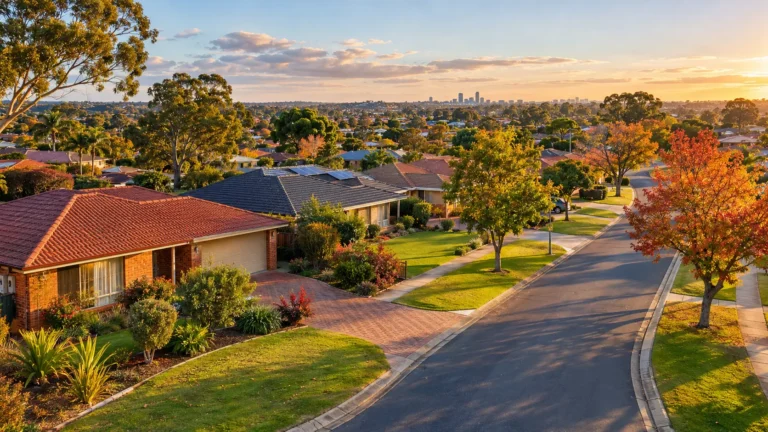
Parkwood real estate had a strong year. Parkwood’s median house price reached $990,000 in the 12 months to October 2026 — a jump of 14.9 per cent year-on-year. Days on market sit at just 29, and rental demand remains strong at $780 per week. Here is what the latest REIWA data tells buyers, sellers, and investors about the Parkwood property market right now.
Parkwood at a glance
Parkwood (postcode 6147) sits about 11 kilometres south of the Perth CBD in the City of Canning. It borders Lynwood to the east, Ferndale to the north, and Langford to the south-east — a cluster of southern-corridor suburbs that have all recorded strong price growth over the past year.
The suburb is well connected by the Armadale rail line (Beckenham and Queens Park stations), Leach Highway, and Orrong Road, making it attractive to buyers who need reasonable access to both the city and the airport corridor.
Parkwood property prices: November 2026
The figures below are drawn from the REIWA Parkwood suburb profile, updated 22 November 2026, covering the 12 months to October 2026.
| Metric | Houses | Units |
|---|---|---|
| Median sale price | $990,000 | $760,000 |
| Annual price growth | +14.9% | — |
| Lower quartile | $830,000 | — |
| Upper quartile | $1,190,000 | — |
| 3-bedroom median | $938,000 | — |
| 4-bedroom median | $1,220,000 | — |
| Days on market | 29 | 44 |
| Median rent | $780 / week | — |
| Annual rental growth | +8.3% | — |
| Rental days on market | 18 | 8 |
What those numbers mean in practice
A 14.9 per cent price rise in 12 months translates to roughly $128,000 added to the median house value in Parkwood. For an owner who bought at the median two years ago, that is meaningful equity — and it explains why listings are moving at a 29-day median, well inside the Perth-wide average.
The spread between the lower and upper quartile — $830,000 to $1.19 million — tells us the suburb has a reasonable range of stock. Entry-level buyers can still find houses priced below the median, while the upper end of the market is now comfortably above $1.2 million for a four-bedroom home.
How Parkwood compares to nearby suburbs
Parkwood does not stand alone. Its southern-corridor neighbours have all recorded strong gains, which helps explain why buyers are still active despite prices being considerably higher than three years ago.
| Suburb | Annual price growth (12 months to Oct 2026) |
|---|---|
| Lynwood | +20.1% |
| Parkwood | +14.9% |
| Langford | +17.2% |
| Canning Vale | +18.5% |
| Willetton | Strong growth |
| Bull Creek / Leeming | Strong growth |
Lynwood’s 20.1 per cent growth is the standout, but Parkwood’s 14.9 per cent is comfortably above the Perth median, suggesting buyers who missed entry points in Lynwood are now looking next door — a common pattern in Perth’s southern suburbs.
Parkwood rental market update
Investors will find the rental picture equally compelling. The median house rent in Parkwood now sits at $780 per week, up 8.3 per cent year-on-year. At that rent on a $990,000 purchase price, the gross rental yield works out to approximately 4.1 per cent — solid for a metro suburb with strong capital growth.
Perhaps more telling is the days on market figure: rental houses in Parkwood are leasing in just 18 days, and units in 8 days. Those are low numbers that reflect a tight vacancy rate and ongoing demand from renters who cannot yet afford to buy, even after several years of wage growth.
If you are thinking about investment property in Perth’s southern suburbs, Parkwood’s combination of price growth and rental demand is worth serious attention. For a broader look at the investment case, see our guide to investment property in Perth.
Perth-wide context: what is driving the market?
Parkwood’s performance sits inside a broader Perth market story. As at mid-November 2026, there were 9,786 properties for sale across Perth — 223.4 per cent above the same time last year, according to REIWA’s weekly market snapshot for the week ending 15 November 2026. Supply is rising, but it has not yet softened prices in well-located suburbs like Parkwood, where demand remains ahead of stock.
The Reserve Bank of Australia raised the cash rate to 4.85 per cent on 3 November 2026, in a 6-3 board vote. The next RBA decision is scheduled for 8 December 2026. At current levels, borrowing costs are meaningful — a $700,000 loan at a typical variable rate of around 6.5 per cent costs roughly $4,400 per month in principal and interest on a 30-year term. Buyers need to model serviceability carefully.
That said, the Perth market has absorbed the current rate environment without the sharp corrections seen in Sydney and Melbourne, partly because Perth’s price base was lower coming out of the pandemic, and partly because population growth (driven by immigration and interstate migration) continues to underpin demand.
Should you buy in Parkwood in 2026?
Deciding whether Parkwood is right for you depends on your circumstances, budget, and goals. Here are some honest observations based on what the data shows.
For owner-occupiers
At a $990,000 median, Parkwood is no longer a “value” suburb by Perth standards — but it has not priced itself out of the conversation either. The suburb offers good transport links, a mix of housing stock (including post-war homes with large blocks that suit knockdown-rebuild), and proximity to the Leach Highway corridor. The 29-day median days on market means well-presented homes are selling quickly, so buyers need pre-approval in place and a clear sense of their ceiling before they inspect.
For investors
The gross yield of approximately 4.1 per cent is respectable in the current market, and rental demand — 18 days to lease a house — is strong. The combination of capital growth (14.9 per cent in 12 months) and income is attractive, though buyers must model the full carrying cost carefully given the RBA’s 4.85 per cent cash rate.
For sellers
If you are thinking about selling, the conditions are as good as they have been in recent memory. Demand is active, days on market are low, and buyers are coming pre-approved. Pricing strategy matters — overpriced listings are still sitting while well-priced ones are going quickly. The goal is to price to the market, not above it.
Not sure what your Parkwood property is worth right now? Our team can give you an accurate, obligation-free appraisal. See how we work out what your home is worth in Perth’s current market, or request a property appraisal today.
What to watch in the Parkwood market over summer
A few things worth watching as we move into late 2026 and early 2027:
- RBA December decision (8 December 2026): Another rate rise would add pressure to buyers’ borrowing power; a hold or cut would likely sustain current demand levels.
- Rising supply across Perth: The 223 per cent increase in properties for sale is a system-wide trend. If that supply continues to build in Parkwood specifically, it could ease competition and moderate days on market.
- Knockdown-rebuild activity: Parkwood has a cohort of older homes on larger blocks. Builder lead times have eased somewhat in 2026, so this segment of the market may become more active over summer.
- Southern corridor momentum: As long as Lynwood and Canning Vale remain expensive relative to Parkwood, spillover demand is likely to continue supporting Parkwood prices.
About Team Gourav & Shan — your Parkwood real estate specialists
Gourav and Shan are senior sales consultants with Harcourts Focus, one of Perth’s most active real estate agencies in the City of Canning and surrounding southern suburbs. They work across Parkwood, Lynwood, Willetton, Bull Creek, Leeming, Ferndale, Langford, and Canning Vale — which means they have live, ground-level insight into what buyers are paying and what sellers are achieving right now.
Browse our current properties for sale, or get in touch directly if you would like to talk through your options in Parkwood.
Conclusion
Parkwood’s property market is in a strong phase: a 14.9 per cent price rise, a 29-day median days on market, and rental yields holding above 4 per cent. The suburb benefits from its position in Perth’s southern corridor, its transport links, and spillover demand from more expensive neighbours. Rising supply across Perth and the RBA’s 4.85 per cent cash rate are headwinds worth watching — but for now, the fundamentals in Parkwood are sound.
Whether you are thinking about buying, selling, or investing in Parkwood, our team is here to help you understand the market and make a confident decision. Contact us for an obligation-free appraisal.
General information only. This article contains general information about property market conditions based on publicly available data sourced from REIWA and the Reserve Bank of Australia. It does not constitute financial, investment, legal, or taxation advice. Property values and market conditions change and past performance is not indicative of future results. You should seek independent professional advice before making any property or financial decision. Median price figures are sourced from REIWA and represent the 12 months to October 2026, updated 22 November 2026.
Frequently asked questions about Parkwood real estate
The median house price in Parkwood is $990,000 for the 12 months to October 2026, according to REIWA data updated 22 November 2026. This represents a 14.9 per cent increase on the same period the previous year.
Parkwood has shown consistent price growth and benefits from good transport links, proximity to the CBD (approximately 11 kilometres), and strong rental demand. Whether it suits your needs depends on your budget, goals, and circumstances. We recommend speaking with a local agent for personalised advice.
Parkwood’s postcode is 6147. It is located in the City of Canning local government area.
The median days on market for houses in Parkwood is 29 days, and for units it is 44 days (12 months to October 2026, REIWA data). Well-presented, correctly priced homes are often selling faster than the median.
At a median rent of $780 per week and a median house price of $990,000, the gross rental yield in Parkwood works out to approximately 4.1 per cent. This does not account for outgoings such as rates, maintenance, management fees, or vacancy. Units rent in just 8 days on median, suggesting very strong rental demand.
The median sale price for a 3-bedroom house in Parkwood is $938,000 for the 12 months to October 2026 (REIWA). A 4-bedroom house has a median of $1,220,000 over the same period.
Parkwood is bordered by Lynwood, Ferndale, Langford, Queens Park, and Beckenham. It is part of the City of Canning and is close to Willetton, Bull Creek, and Canning Vale — all suburbs that have recorded strong property price growth in 2025 and 2026.
The best way to find out your property’s current value is to request an appraisal from a local agent who is active in the suburb right now. Online estimates are a starting point but do not account for your property’s specific condition, presentation, or recent comparable sales. Request a free appraisal from our team — we know the Parkwood market and can give you an accurate current-market figure.